DIGITALISATION AND INNOVATION – A KEY ENABLER IN CDL’S DECARBONISATION JOURNEY
Innovation has been a cornerstone of our decarbonisation journey and has remained one of the Group’s most highly prioritised material ESG issues since 2017. As we transition to a low-carbon future, we continue to harness innovation and digitalisation to drive business growth and support the Group’s transformation.
Enterprise Innovation Committee
At the corporate level, the Group has a dedicated cross-functional committee, established by our Group CEO in 2018. Chaired by our Group COO, the Enterprise Innovation Committee (EIC) curates and implements customer and digital-centric solutions that create near and long-term business value for the organisation.
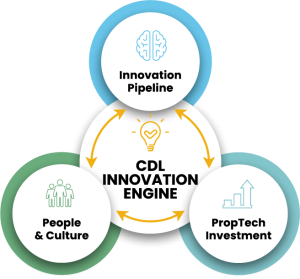
EIC identifies scalable technology to reduce our carbon footprint in the way we design, build, and manage our assets. The Group recognises that a circular economy goes hand-in-hand with clean energy solutions to realise a net-zero future. These activities are powered by three mutually reinforcing innovation engines: (1) Innovation Pipeline; (2) People and Culture; and (3) PropTech Investment. For more information on our EIC, see CDL ISR 2022.
INVESTING IN GREENER, SAFER AND SMARTER ASSETS
Investing in green assets has become a critical strategy for addressing climate change and driving long-term value creation. By prioritising green assets and innovation, the Company drives business value while realising our net-zero aspirations. The following initiatives which were piloted in 2025 reflects the Group’s commitment in decarbonisation and using digitalisation to strengthen our business operations. These highlights are non-exhaustive.
| IoT-based Optimisation and Energy Monitoring Platform |
|
| Advanced Electronically Commutated (EC) Fan in Orchard Hotel |
|
| Predictive Control System |
|
| Anti-Microbe Silver Ion Coating |
|