ENSURING SUPPLY CHAIN RESILIENCE AND SUSTAINABLE SOURCING
With our pledge to the WGBC’s Net Zero Carbon Buildings Commitment and responsibility towards green and responsible procurement, consistent engagement with our supply chain is pivotal for a net-zero whole life carbon-built environment.
For many businesses worldwide, Scope 3 emissions can account for more than 70% of their carbon footprint.1 Measuring and managing these emissions motivates a company to choose more sustainable suppliers, improve the energy efficiency of its products, and rethink its sourcing and distribution network — measures that can significantly reduce the overall climate impact.
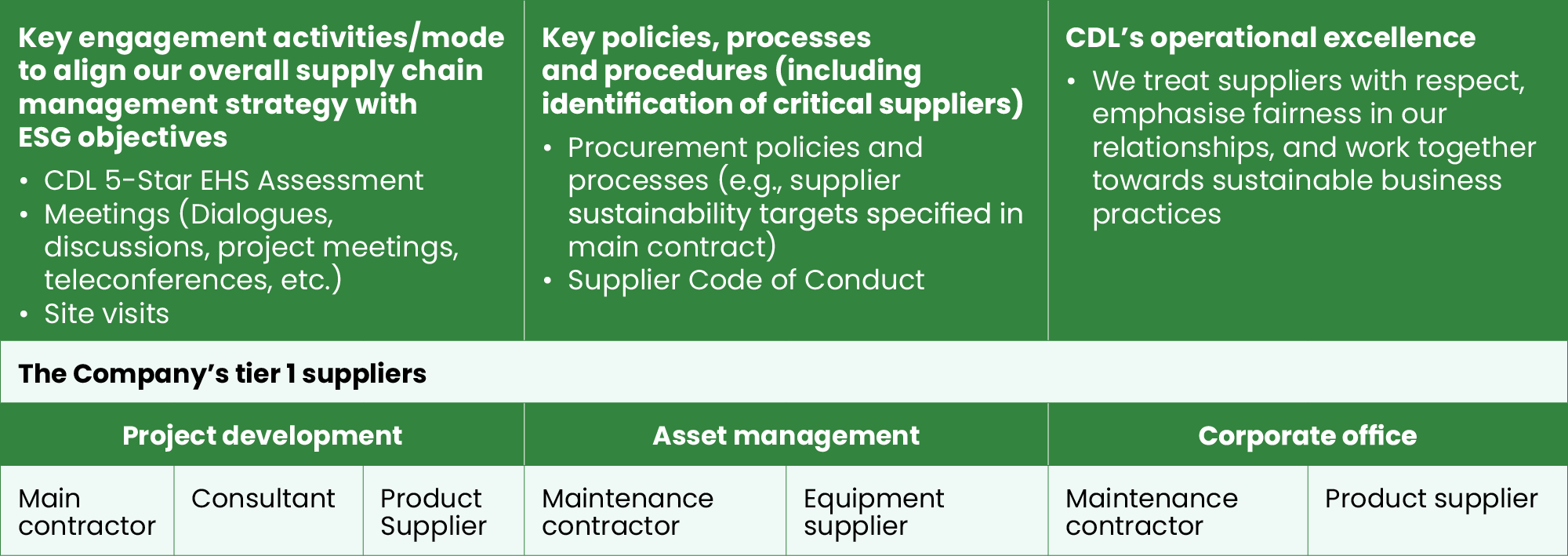
Supply Chain, Supplier Risk Analysis And Critical Supplier Identification
The Company engages various types of suppliers across our value chain and operations. We identify and work closely together with our tier 1 supply chain partners to prevent disruption to delivering quality products and services. In 2025, there were more than 1,700 tier 1 suppliers for CDL. 11 of them were considered as our significant suppliers.2
Procurement Of Sustainable Materials
For over a decade, the Company has implemented sustainable procurement guidelines that set clear specifications for responsible sourcing along our supply chain. This includes the Responsible Procurement Guidelines since 2008, and the Green Procurement Guidelines for property developments since 2009. These guidelines encourage the use of eco-friendly and recycled materials that have been certified by approved local certification bodies, such as the Singapore Green Building Council (SGBC) and the Singapore Environment Council (SEC).
Our green procurement guidelines also indicate our preference for ISO 14001, ISO 45001, and bizSAFE Level 3 certified vendors. In key operations like property development and asset management, major suppliers and builders must meet the environment, health and safety (EHS) pre-qualification criteria. All suppliers are required to sign a supplier code of conduct, which provides comprehensive guiding principles for our vendors and suppliers to comply with the Company’s expectations, including information on our anti-corruption practices, environment, health, safety, and ethical employment. In 2025, 100%3 of our main contractors and key consultants for property development had recognised EHS certifications. In our asset management division, 100%3 of suppliers4 appointed were certified by recognised EHS standards.
Introduction of CDL Green Procurement Policy
In early 2026, CDL launched the CDL Green Procurement Policy which guides the integration of sustainability considerations into our sourcing decisions, ensuring that environmental responsibility is embedded across our supply chain. It sets clear expectations on carbon reduction, responsible material selection and nature-related considerations, while aligning suppliers with our broader sustainability commitments. Through this policy, CDL aims to drive more resilient, low-carbon and nature-positive outcomes across our developments. For more information, please refer to this link for more information.
Supply Chain Engagement
The Company manages supply chain risks through regular engagement with upstream suppliers and alignment of operational policies with evolving regulatory requirements. In 2019, we conducted a comprehensive segmentation study of our top 100 suppliers (assessed based on spend and predominantly Singapore-based) and five key raw materials, strengthening our understanding of emerging risks and opportunities — including automation, climate change, forced labour and migrant labour risks. As our supply chain profile remains largely unchanged in 2025, the findings of this study continue to inform our approach to managing labour-related risks across the region.
To ensure a healthy and safe working environment, the Company’s Management Executive Committee (ExCo), senior management and key executives regularly engage with workers across our construction sites, managed buildings, hotels, and corporate office on EHS matters. The Company continued to expand our support for our main contractors by guiding them on the use of advanced carbon calculation tools and accounting methods to evaluate the embodied carbon of their respective projects completed in 2025. The aggregated data was eventually externally audited in accordance with ISO 14064 Greenhouse Gas standards.
Building on this experience, the Company became the first developer to launch the CDL SME Supplier Decarbonisation Queen Bee Programme, dedicated to equipping small and medium enterprises (SME) suppliers with the knowledge, tools, and digital platforms to measure, manage, and reduce their carbon emissions. Launched in 2024 with the support of Enterprise Singapore (EnterpriseSG), the programme is a collaboration with a sustainability consultant, Global Green Connect (GGC), alongside carbon accounting IT solution providers, and DBS Bank. By empowering SMEs to adopt carbon accounting, develop decarbonisation roadmaps, and align with global reporting frameworks, the programme strengthens supply chain resilience and ensures that smaller businesses remain competitive in a rapidly evolving low-carbon economy. In 2025, we celebrated the graduation of the first 42 local SMEs at a graduation ceremony officiated by Guest-of-Honour, Low Yen Ling, Senior Minister of State (SMS) for Trade and Industry, and Culture, Community and Youth.
| 1 | How scope 3 emissions are key to decarbonisation, World Economic Forum |
| 2 | Most of these suppliers were based in Singapore, as the majority of our property developments and managed assets are located in Singapore. Our significant suppliers made up approximately 80% of our total spend. As part of our supplier assessment, suppliers with substantial actual/potential negative ESG impacts will not be approved to work with CDL. As of end 2025, no suppliers were terminated from having substantial or potential negative ESG impacts. |
| 3 | Of the new suppliers appointed in 2025 by AM and PD, 91% were certified by recognised social certifications including health and safety standards (e.g., ISO 45001 and minimum bizSAFE Level 3 certificates) and 27% were certified by recognised environmental standards (e.g., ISO 14001). |
| 4 | For asset management, this target applies to vendors engaged for proprietary equipment service and maintenance, facility management, security and cleaning service in the reporting year. |