TURNING RISKS INTO OPPORTUNITIES WITH OUR VALUE CHAIN
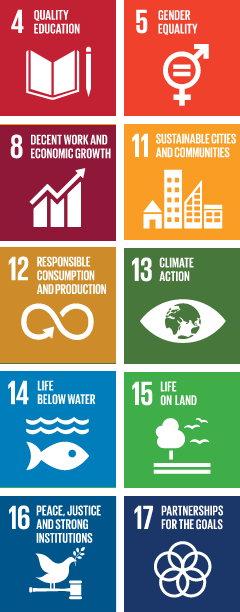
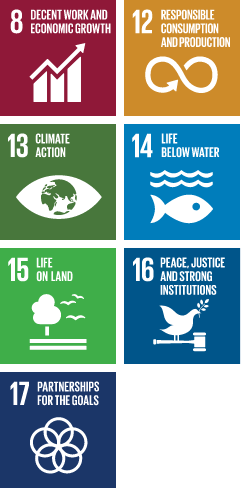
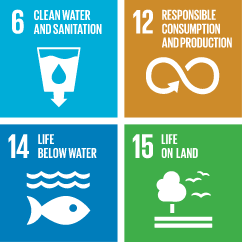
The table below outlines our actions in addressing risks and opportunities that are related to the Group’s top 16 material ESG issues. They are mapped to 15 relevant UN SDGs and the TNFD framework. Some of these ESG risks and opportunities are also captured in CDL’s Enterprise Risk Management (ERM) framework, which can be found in the Risk Management section in CDL’s Annual Report 2025.
Legend for TNFD Pillars:
Governance (G), Strategy (S), Risk Management (RM), Metrics & Targets (M&T)
Please slide left to view more.
| CDL Group’s top material ESG issues | Risks and Opportunities | CDL Group’s management approach and achievements |
| 1. Decarbonisation – Energy Efficiency and Adoption of Renewables
Supporting SDGs: TNFD Pillars: G, S, RM |
Energy consumption contributes a large portion of our carbon footprint. As a leading green developer, the Group implements low-carbon strategies for our managed buildings and continuously sources for emerging solutions that can optimise energy efficiency across our diversified portfolio.
Clean, renewable energy options are also limited in Singapore due to land and resource constraints. Despite this, we remain committed to be early adopters of green energy procurement to propel Singapore towards achieving its SG Green Plan targets. |
We obtained 130 BCA Green Mark awards since the launch of the scheme in 2008. In 2025, our new residential development, Zyon Grand, achieved the BCA Green Mark Platinum SLE award as well as the BCA Health and Wellbeing, Maintainability, and Whole Life Carbon badges.
On-site solar photovoltaic (PV) systems were also deployed across selected retail, office and industrial assets under a Solar Power Purchase Agreement (PPA) model in 2025. These PV systems supply renewable energy and are estimated to save approximately 1,000,000kWh per year, equivalent to about 200 4-room HDB flats per annum. The Solar PPA was implemented at City Square Mall, Quayside Isle, King’s Centre, Palais Renaissance and City Industrial Building. Jungceylon Shopping Center in Phuket was a winner in the Thailand Energy Awards 2025, in recognition of its efforts in energy efficiency, renewable energy integration, and exemplary management of environmental impacts. The Company first piloted the City Green Tenant Bonus (CGTB) Programme in 2024. In 2025, we recognised tenants who achieved at least a 10% reduction in their 2024 energy use at the inaugural CGTB Programme Awards Ceremony, encouraging broader behavioural change across our tenant community. In 2025, we completed the installation of hybrid cooling fans at our corporate office in Republic Plaza, to balance occupant comfort and energy efficiency. This complements the raised indoor air-conditioning temperature of 25°C and is aligned with Singapore’s Go 25 movement, which promotes sustainable cooling practices. Through dedicated tracking, monitoring and improvements in energy efficiency, the Company has achieved cost savings of approximately S$47.5 million from reduced energy expenses across all our locally managed buildings since 2012. Regular asset upgrading and enhancement efforts since 2004 have helped the Company to maintain good energy performance for our existing managed buildings. M&C hotels began the removal of key card electricity control and installation of Room Control Units (RCUs) for all guest rooms in 2025. RCUs promote energy efficiency by using sensors to allow greater control over in-room electricity use. |
| 2. Cyber-readiness, Security and Data Privacy
Supporting SDGs: |
Security breaches are rising with the evolving cyberthreat landscape. Cybersecurity is now a financially material issue that must be diligently managed to protect corporate value.
Ensuring the security and resilience of the Group’s networks and information systems is critical. Strengthening our capabilities to protect ourselves and respond to cyber-attacks is vital in preventing data theft, financial loss, and disruption of operations. |
Holistic IT governance structures and robust detection and mitigation measures have been developed to protect the Group’s critical business systems and data. The Company’s response plans are rigorously tested by internal auditors and an external professional firm to enhance alignment with industry best practices.
Cybersecurity key risk indicators, including any cyber incidents, are reported quarterly to the CDL Risk Management Committee. In addition, IT Risk Reports are submitted to CDL’s Audit Risk Committee on an annual basis. In 2025, there were zero cyber-security related breaches. CDL adopts a robust Group-level Cybersecurity Framework to protect the confidentiality, integrity, and availability of our digital assets. In 2025, the Company refined our “CDL Computer Security Policies & Standards” and established a comprehensive Artificial Intelligence (AI) Governance and Security Framework to govern the responsible use of GenAI technologies and to oversee AI-related risks. Our employees’ IT security heightened awareness and vigilance are maintained through cybersecurity training courses, complemented by periodic phishing attack simulations. All M&C staff are also required to complete a multi-module course on Data Privacy and Cybersecurity annually. |
| 3. Green and Healthy Buildings – Product/Service Quality and Responsibility
Supporting SDGs: TNFD Pillars: G, S, RM, M&T |
Green and healthy buildings positively impact the health and well-being of occupants. Investing in green buildings rewards businesses with occupant satisfaction and increased staff productivity.
Quality and sustainable spaces that embed green features and promote healthy lifestyles in our office buildings and residential developments are continually being created. Creative design and technology optimise overall well-being and create a shared sense of community. As an asset owner and manager, the Group takes pride in ensuring a safe, green and healthy environment for our building users. We remain committed to delivering safe, high-quality products and services for our homebuyers and tenants with smart building and energy-efficient features. |
It is the Group’s responsibility to provide a safe and healthy environment for our employees, customers, and workers. In 2025, nine CDL properties in Singapore maintained the WELL Health-Safety Rating in 2025. The certified assets were assessed based on their building performance in sustainability, health and well-being via a global rating system developed by the International WELL Building Institute.
To ensure compliance and prevent latent defects, the Company has a robust process guided by the Design for Safety Regulations to identify design risks and assess the severity of EHS impacts throughout the construction stages of our developments. In 2025, homebuyers of Irwell Hill Residences, Copen Grand, and Tembusu Grand were engaged both in-person and virtually via our app, CityNexus-Home. 13 customer engagement events, from webinars and online contests to handover briefings were organised in the year. More than 1,700 homebuyers participated in these events. Our key subsidiaries, M&C and CBM Pte Ltd, are dedicated to excellent customer service and experience. In 2025’s customer satisfaction surveys, both subsidiaries achieved higher-than-expected customer satisfaction rates. |
| 4. Occupational Health, Safety and Well-being
Supporting SDGs: TNFD Pillars: S, RM |
The safety, health and wellness of the Group’s employees and contractors’ workers are consistently ranked amongst our top priorities.
In line with Singapore’s Workplace Safety and Health (WSH) 2028 Roadmap, we collaborate with appointed contractors to promote good WSH practices on-site and in our offices, contributing to a strong EHS culture. |
The Company continues to be recognised as a long-serving bizSAFE Mentor in 2025. Some of our EHS-related achievements include:
In 2025, we were awarded the WSH Developer Award 2025 marking our 13th win of this award. CDL’s main contractors also achieved the Safety and Health Award Recognition for Projects (SHARP) for The Myst, Tembusu Grand, Newport Plaza, Lumina Grand Executive Condominium, and Irwell Hill Residences. Similar practices are implemented at our subsidiary, CBM Pte Ltd, which developed and deployed the CBM Safety App to manage on-site safety through real-time reporting and monitoring. CBM also enhanced its e-Attendance system to allow tracking of individuals’ health status before and after their shifts, allowing for prompt management of health and safety risks. |
| 5. Governance and Business Conduct
Supporting SDGs: |
An ethical and transparent business builds and maintains a company’s trust with its stakeholders and promotes investor confidence, customer loyalty and sustainable business growth.
The Group takes a firm stance on our zero-tolerance policy towards fraud, bribery and corruption. This leads to greater opportunities such as access to capital and mitigates risks associated with legal, financial and reputational damage. |
To minimise gaps, the Company benchmarks our practices with the Singapore Standard ISO 37001 Anti Bribery Management Systems. Clear and transparent policies, risk management systems, and disclosures to continuously monitor and validate business processes have also been implemented by the Group. Within the Company’s robust EHS Management System, applicable legal requirements are regularly monitored and evaluated for compliance. Incentives and penalties are also implemented to strengthen contractors’ site management.
Annually, all our full- and part-time employees are required to complete a compulsory online declaration to acknowledge that they are aware of, have read, and are in compliance with CDL’s corporate policies and guidelines before the start of the calendar year. Mandatory training is provided to all new hires on key risk management-related topics (namely Anti Money Laundering, Counter Financing of Terrorism and Counter Proliferation Financing Policy, Data Privacy, and Incident Notification and Management). Anti Money Laundering refresher training is also conducted periodically for internal stakeholders. Corporate and sustainability policies and guidelines by the Company are published on our corporate websites, sustainability microsite and staff intranet, CDL360. |
| 6. Climate Resilience and Adaptation
Supporting SDGs: TNFD Pillars: G, S, RM, M&T |
Stranding risks are becoming more critical in the property and construction sector. Embedding climate resilience in line with a low-carbon future is therefore key to our sustainable growth strategy.
The built sector contributes to 39% of global energy-related carbon emissions, and remains heavily reliant on natural resources. Heightened demand for clean energy, cost-efficient and market-ready circular economy solutions are both opportunities and risks to maintaining profitability and sustained growth in the short- to medium-term. |
In December 2025, the Group completed our fourth climate change scenario study, expanding on the financial impact from potential physical and transition risks based on orderly and disorderly scenarios for 1.5°C and >3°C warmer conditions in 2030, 2040 and 2050. The scope was expanded to include a wider portfolio comprising hotels, investment properties and new developments across six key markets: United States, United Kingdom, China, Singapore, New Zealand and Japan, with greater asset granularity of information used. For more information, please refer to Chapter 3 of the CDL ISR 2026.
The Company committed to the WorldGBC Net Zero Carbon Commitment in February 2021. The Company’s decarbonisation roadmap aims to achieve a 63% reduction in Scope 1 and 2 emissions, alongside a Scope 3 emissions reduction of 41% in embodied carbon and 58.8% in investments. To achieve our SBTi-validated targets aligned with a 1.5°C future, decarbonisation efforts continue to involve multi-business unit collaborations facilitated by the Green Building, Decarbonisation and Safety department. |
| 7. Future-ready Workforce and Talent Retention & Attraction
Supporting SDGs: TCFD Pillars: S, RM |
Successfully attracting and retaining talent allow companies to have a strong competitive advantage in corporate performance.
The Group strives to be ahead of the curve in ensuring employee satisfaction, productivity and well-being, and building a workforce with skill sets that future-proof our business. |
The Group champions a culture of continuous learning and development, prioritising ongoing training and development programmes, which is key to building a future-ready workforce. We have enhanced our in-person training programmes to cover diverse topics including sustainability, health and wellness, and leadership programmes. This has led to improvements in employee engagement, resulting in lower-than-industry turnover rates.
The Company’s skills-based hiring approach emphasises specific competencies and transferable skills, enabling us to prioritise technical and soft skills over educational qualifications, while reducing unconscious bias. To maintain consistency and objectivity, we use an interview assessment form with standardised questions to evaluate each candidate’s suitability for the role. To strengthen leadership continuity, the Company has implemented a structured leadership competency framework and succession planning process across key roles, enabling earlier identification, development, and readiness of future leaders. Beyond external attraction, the Company places strong emphasis on internal mobility and career progression, supported by transparent role expectations, performance development conversations, and targeted stretch opportunities to retain and grow critical capabilities from within. |
| 8. Innovation and Solutions
Supporting SDGs: TNFD Pillars: S, RM |
Innovation is a key strategic focus of CDL’s Growth, Enhancement and Transformation (GET) strategy and serves as an enabler to help us achieve our ESG goals and targets, while future-proofing our business.
Through partnerships and collaborations, the Group has actively sourced for low-carbon and innovative solutions to test bed at our development projects and managed buildings. In-house solutions leveraging technology also add and deliver exceptional value to our customers and prospective homebuyers. |
Our GET strategy focuses on leveraging innovative and green solutions for the business to grow, enhance and transform. In recent years, we have stepped up on cooling urban spaces by greening, circularity and nature-based solutions.
In 2025, we continued to leverage innovative green building technologies and decarbonisation solutions across the life stages of an asset. We piloted an Internet of Things (IoT)-based Optimisation and Energy Monitoring Platform at Jungceylon Shopping Center, Phuket, which enables real-time visibility, operational efficiency, and proactive fault detection. With further integration across other building systems, the platform is expected to deliver potential energy savings of up to 10%. The Company installed advanced electronically commutated (EC) fans at Orchard Hotel’s level 1 Lobby & Bar Intermezzo. The EC fan can achieve up to 40% energy savings. Coupled with the IoT Optimisation system, this can potentially improve energy savings up to about 70-80% per year. |
| 9. Human Rights and Labour Conditions
Supporting SDGs: TNFD Pillars: G |
Creating a workplace that provides a decent work environment, fair remuneration, security in the workplace, freedom of expression, work-life balance and career growth, is critical to building a sustainable workforce.
The Group is committed to respecting and promoting the rights and dignity of our employees, workers and communities. |
Biennial employee engagement surveys are carried out by the Company and CBM Pte Ltd to understand our employees’ concerns and engagement levels, strengthening our performance and reputation as an employer of choice. Regular salary reviews are conducted, and a suite of flexible benefits options are provided for our employees.
To promote EHS awareness and employee well-being, we offer mental health and mindfulness workshops, counselling support, on-site health screenings, and weekly fruit distributions. In 2025, CDL implemented targeted competency training on Well-being Responder: Psychological First Aid. 37 selected employees, including leaders, were equipped with practical skills to support employee well-being and manage psychosocial risks. The Company’s contractors and suppliers abide by our principles and policies such as the Supplier Code of Conduct, Human Rights Policy, and Universal Design Policy. Since 2001, the CDL 5-Star EHS Assessment – an independent audit tool to assess, measure, and improve our main contractors’ EHS management and performance – has been in place to ensure a comprehensive, audited, and appraised approach. At CBM Pte Ltd, EHS matters are discussed at management and risk management committee meetings to ensure timely updates to all business units. |
| 10. Stakeholder Impact and Partnerships
Supporting SDGs: TNFD Pillars: G, S |
Building goodwill in the community provides the Group with a strong social license to operate. Through collaborations with like-minded partners, we have pioneered and developed partnerships that multiply our outreach and impact on climate action and the UN SDGs. | The “We Love Our Planet” climate exhibition was held at the CDL Green Gallery from 10 December 2024 to 1 June 2025 and was organised in partnership with the National Parks Board, the Jane Goodall Institute (Singapore), and Ocean Geographic. Drawing nearly 22,000 local and international visitors, the exhibition highlighted the vital role of nature and biodiversity in sustaining ecosystem resilience and tackling the climate crisis. Launched in February 2026, the second “Melting Ice, Sinking Cities – the Arctic Impact” Climate Exhibition invites visitors to confront the climate emergency in the polar region through the findings of the 2025 Bears Ice Glaciers Arctic Climate Expedition.
The CDL EcoTrain, launched in March 2025, welcomed over 70,000 visitors since its opening in March in 2025 and is slated for a revamp in April 2026. In 2025, more than 220 events covering climate and nature advocacy were held at the Singapore Sustainability Academy and Annex, engaging over 11,500 participants. Key events, including major initiatives such as the Youth4Climate Festival, My Tree House “We Love Our Planet” Storytelling Contest, and the CDL-GCNS Young SDG Leaders Award, continued to be held. Read more about our stakeholder engagement initiatives in Chapter 5 of the CDL ISR 2026. In 2025, CDL Group continued to support Assisi Hospice’s fundraising efforts at its annual Assisi Fun Day. Collectively, close to S$40,000 of proceeds were raised while M&C also contributed donations-in-kind, including F&B and hotel vouchers towards the event’s lucky draw. S$150,000 was raised through the CDL Challenge – a special charity segment led by CDL’s Group CEO that rallied donations from stakeholders, staff and business partners. |
| 11. Responsible Supply Chain
Supporting SDGs: TNFD Pillars: G, S, RM, M&T |
With mandatory reporting on Scope 3 emissions potentially required as soon as FY2026 by the SGX RegCo, listed companies must act responsibly by building capacity within their supply and value chains.
Our Group’s ESG performance and reputation is upheld through established processes and regular engagement with our suppliers to procure sustainably sourced and safe building materials, ensure fair labour human rights practices for workers and provide healthy buildings for building occupiers. |
Responsible sourcing guidelines have been established for our supply chain – this includes the implementation of the Responsible Procurement Guidelines since 2008 and the Green Procurement Guidelines for property developments since 2009.
In line with the Company’s corporate EHS Policy established in 2003, regularly updated guidelines encourage the use of eco-friendly and recycled materials certified by approved local certification bodies, such as the Singapore Green Building Council and Singapore Environment Council. The Company supports our main contractors in the tabulation of carbon emission data associated with building materials outlined in ISO 14064 greenhouse gases standards, contributing to their sustainability proficiency. In October 2025, we marked a major milestone in our SME Supplier Decarbonisation Queen Bee Programme by celebrating the graduation of the first 42 local SMEs. For more information, please refer to Chapters 3 and 4 of the CDL ISR 2026. |
| 12. Water Management
Supporting SDGs: TNFD Pillars: G, S, RM, M&T |
In Singapore, it is increasingly more expensive to produce and supply water. The Singapore government is progressively increasing the price of water from April 2024 onwards. Due to climate change, more investment is needed in local water infrastructure to prepare Singapore for drier days ahead. | Our developments are designed with a life cycle approach to water sustainability. We adopt technologies to raise water efficiency such as rainwater harvesting, which are implemented at many of our commercial and residential developments.
Addressing Singapore’s water challenges through conservation and rainwater harvesting, where feasible, has been a priority for the Company. We partner with PUB – Singapore’s national water agency – annually for Singapore World Water Day, by engaging our corporate staff, tenants and members of the public. |
| 13. Sustainable Finance
Supporting SDGs: TNFD Pillars: G, S, RM |
Climate finance and carbon markets took centre stage at COP30, which strongly focused on increasing funding for climate action and creating effective carbon market mechanisms.
Companies that lag in their ESG performance could be penalised through higher cost of debt financing or face divestment from shareholders. |
As of 31 December 2025, the Company has completed over S$11 billion of sustainable financing, including green bonds, green loans, and sustainability-linked loans, with S$5.7 billion of our sustainable finance amassed deployed to finance our existing investments and/or assets.
The Company is a signatory to the UN Principles for Responsible Investment (PRI). We have also developed the CDL Sustainable Investment Principles to steward responsible capital allocation and decision-making for investments. |
| 14. Waste Management and Circularity
Supporting SDGs: TNFD Pillars: G, S, RM, M&T |
With increased regulation, changing consumer behaviour and shifting corporate practices, accelerated momentum towards more sustainable water and waste practices are expected in the short- to medium-term. | At the Company’s commercial and retail properties, recycling bins and facilities are provided to encourage the recycling of paper, plastic and metal by shoppers and tenants. Circular solutions are also sourced through innovation partnerships and startup competitions.
To instill a ‘waste-less’ mindset amongst employees, training is conducted for our Group employees to raise awareness on topics like circularity and waste management through workshops, learning trips, and seminars. |
| 15. Nature and Biodiversity Conservation
Supporting SDGs: TNFD Pillars: G, S, RM, M&T |
The Global Biodiversity Framework’s Target 15 calls for businesses to assess and disclose biodiversity dependencies, impacts and risks, and reduce negative impacts.
As a leading green, nature-positive developer, the Company embraces biophilic design across our assets and incorporates nature-based solutions (where applicable) via green roofs and walls or active green spaces. |
In March 2025, we launched the CDL MicroForest, a 2,800 square feet regenerative tropical microforest, developed in collaboration with experts in ecology and biological sciences from the National University of Singapore and with inputs from the National Parks Board. This pioneering nature-based solution for cooling through greening aims to combat urban heat and biodiversity loss in high-density urban landscapes, serving as a living laboratory to study how microforests can lower temperatures, boost biodiversity and enhance ecological resilience.
In 2024, the Company updated our Biodiversity Policy, first established in 2020, to include more details of our Biodiversity Management System and the interconnectivity of land ecosystems with marine biodiversity and ecosystems. |
| 16. Diversity, Equity and Inclusion (DEI)
Supporting SDGs: |
Embracing diversity, equity and inclusion contributes to a positive work culture and improved productivity, as employees feel valued and respected regardless of their gender, age, race and accessibility needs.
Socially responsible businesses should embed diversity and inclusion principles into recruitment practices, opportunities for advancement and remuneration policies. |
Robust recruitment processes grounded in non-discrimination, fairness and inclusivity, ensuring equal opportunity for all candidates regardless of gender, ethnicity, religion, or age have been established by the Group.
Reflecting our commitment to meritocracy, our compensation and rewards policies are performance-based, promoting a culture of fairness and motivation. We monitor and address gender pay gaps, ensuring equitable remuneration across various staff levels. Our workforce diversity is further enriched by our inclusive workplace culture, with employees hailing from a variety of ethnic backgrounds. Since 2023, the Group has introduced a DEI Policy to ensure a dignity-centred workplace where all employees are mutually respected. |